A data-driven reality check on pier-and-beam sustainability claims
The Greenwashed Pier
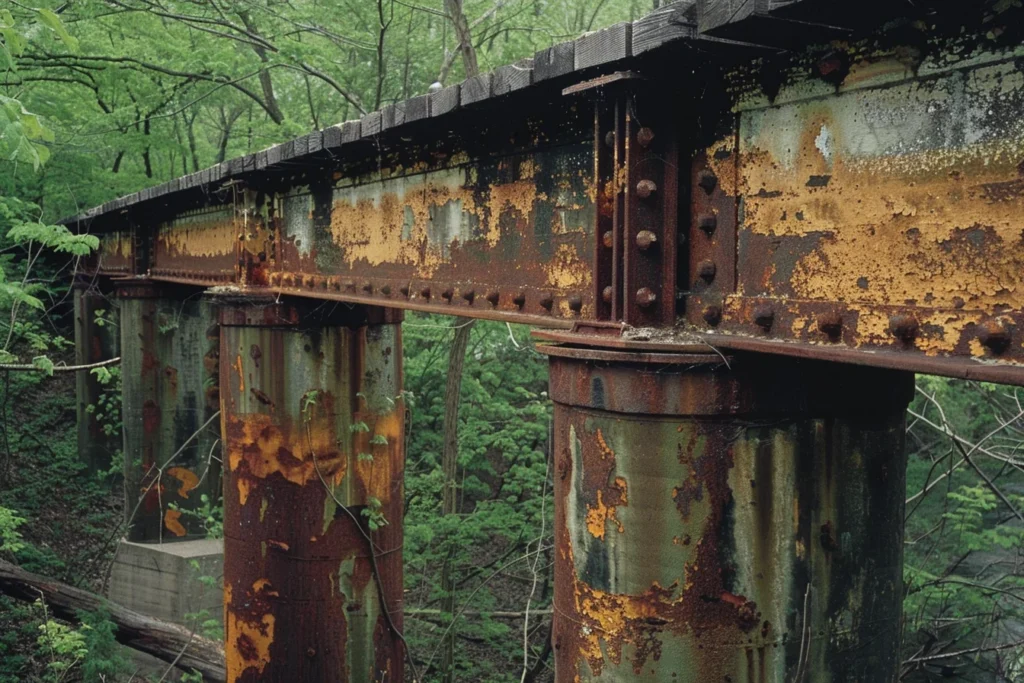
In the name of sustainability, architects have raised entire buildings off the ground.
The pitch is compelling: elevate your structure, save the trees, minimize site disturbance, tread lightly on the earth. You’ve seen the portfolio photos—sleek steel-framed homes hovering above forest floors, boardwalks threading through wetlands, pavilions perched delicately among oak groves.
The elevated structure has become shorthand for environmental consciousness. It says: We care. We didn’t bulldoze. We floated above the problem.
But sometimes what we lift up comes back down—literally.
Beneath those elegant portfolios lies a more complicated story: corroded steel piers requiring replacement at year twelve. Thermal bridging that doubles heating loads. Concentrated runoff creating erosion gullies worse than a conventional foundation would have caused. Maintenance costs that exceed the initial “savings” from site preservation.
This isn’t an argument against all elevated structures. It’s a question about when elevation actually serves sustainability—and when it merely performs it.
Is lifting a structure truly lighter on the planet?
The answer depends entirely on context. And the contexts where elevation makes genuine environmental sense are narrower than current architectural fashion suggests.
The Origin Story of the Elevated Ideal
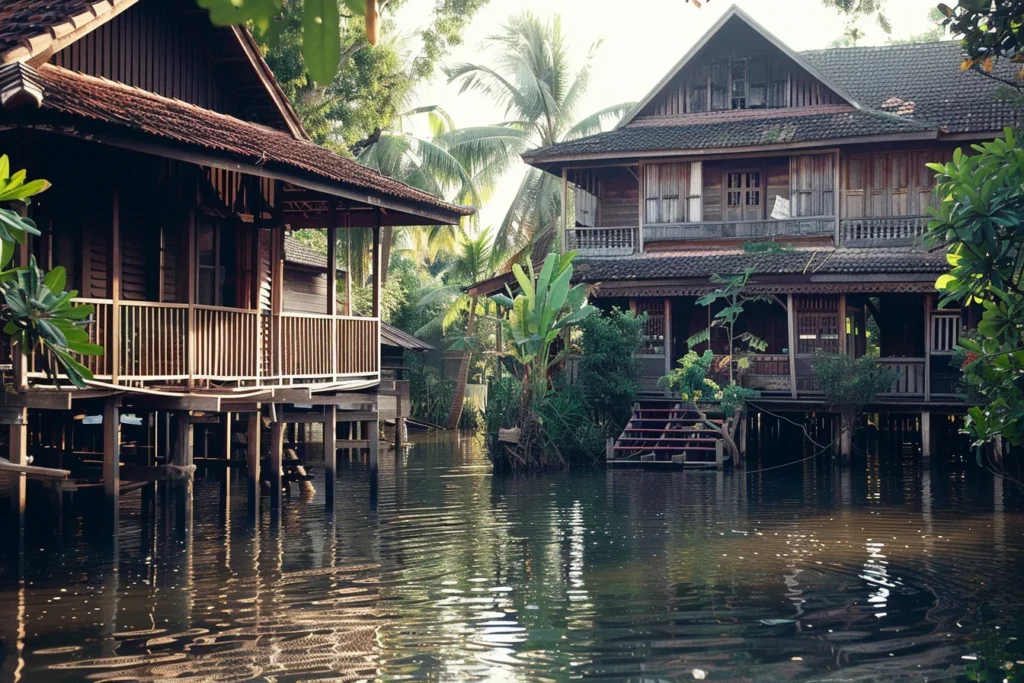
To understand how we arrived at “elevate everything,” we need to trace the lineage.
Vernacular Wisdom
Elevated structures have deep roots in tropical and flood-prone regions. Thai stilt houses, Melanesian pile dwellings, Queenslander homes—these weren’t aesthetic choices. They were survival strategies.
Elevation solved specific, measurable problems:
- Flood resilience in monsoon zones
- Ventilation in hot, humid climates where rising heat beneath the structure created natural airflow
- Pest control by raising living spaces above ground-dwelling insects and rodents
- Food storage in cool, dry, elevated spaces
These structures emerged from centuries of environmental observation. They were appropriate technology for their context.
The Translation Problem
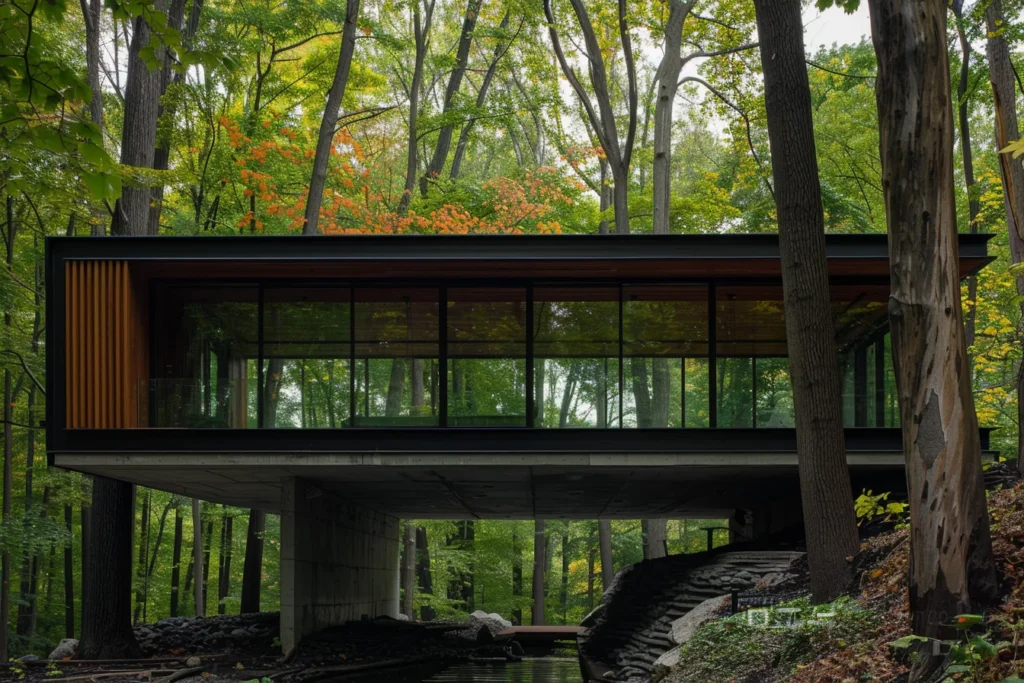
What happened in the late 20th and early 21st centuries was a translation of this vernacular strategy into a universal environmental aesthetic.
As sustainability became a design imperative, elevated structures migrated from their original contexts—tropical floodplains, steep coastal sites—into temperate forests, suburban hillsides, and relatively flat sites where the traditional justifications didn’t apply.
The logic shifted from “We must elevate to survive” to “We should elevate to preserve.”
Instagram Sustainability
Elevated walkways and hovering pavilions photograph beautifully. They provide dramatic cantilevers, views through tree canopies, and a visible gesture toward minimal site impact. They signal environmental virtue in a way a slab foundation simply can’t.
This is “Instagram sustainability”—design choices driven more by how they communicate environmental values than by their actual environmental performance.
Dr. Emma Whitfield, environmental design researcher at MIT, studies the gap between perceived and measured sustainability: “We’ve documented dozens of projects where the elevated structure became a marketing centerpiece—’We saved every tree!’—while the lifecycle analysis showed significantly higher carbon footprint than selective removal and conventional construction would have generated. The elevation wasn’t serving the environment. It was serving the brand narrative.”
The Embodied Carbon Reality
Let’s run the numbers that rarely appear in the glossy project features.
Material Intensity Comparison
Consider a 2,000 square foot single-story structure in a temperate climate (no flood risk, moderate slope).
Option A: Conventional slab-on-grade
- 6-inch concrete slab with WWF and vapor barrier
- Perimeter insulation
- Minimal excavation (8-12 inches)
- Embodied carbon: ~48 lbs CO₂/sq ft
- Total: 96,000 lbs CO₂
Option B: Elevated steel pier-and-beam
- 16-20 steel piers, 6-10 feet deep
- Steel beam grid
- Floor joists and subfloor
- Elevated decking system
- Bracing and connections
- Embodied carbon: ~67 lbs CO₂/sq ft
- Total: 134,000 lbs CO₂
Delta: +38,000 lbs CO₂ (39% increase)
This is before accounting for:
- Increased heating/cooling loads from thermal bridging
- Replacement cycles for deck materials (typically 15-25 years vs. 50+ for slab)
- Maintenance materials (paint, sealants, structural repair)
Material | CO₂ per lb | Typical Use in Elevated Structures
Steel (structural)| 1.85 lbs | Piers, beams, connections
Concrete | 0.45 lbs | Pier footings
Pressure-treated | 0.52 lbs | Decking, framing
Composite decking | 2.10 lbs | Premium deck surface
Galvanized steel | 2.20 lbs | Corrosion-resistant applications
The Expert Perspective
James Liu (the same carbon accountant we consulted for tree preservation math) provided context: “The paradox is that people choose elevation to avoid disturbing a 40-square-foot area where a few trees grow, but in doing so they specify materials that generate 20-30 tons of additional CO₂. They’ve optimized for visible site impact while externalizing the carbon impact.”
He continued: “If you remove two mature trees—call it 2,000 lbs of standing sequestered carbon—but avoid 38,000 lbs of embodied carbon in the structure, you’re carbon-positive on day one. Those removed trees can be replaced with saplings that will recapture that carbon within 15-20 years, while the avoided structural carbon is a permanent benefit.”
“You saved two trees, but added ten tons of steel.”
— James Liu, environmental consultanT
When the Math Reverses
There are scenarios where elevation’s embodied carbon is justified:
- Genuine flood risk where the alternative is repeated flood damage and reconstruction
- Archeological or ecological preservation where site disturbance would cause irreversible loss
- Extremely steep slopes where conventional foundation would require massive cut-and-fill
But for a typical residential or small commercial project in temperate zones without these conditions? The carbon math rarely supports elevation.
The Performance Penalties
Beyond embodied carbon, elevated structures introduce operational inefficiencies that persist for the building’s lifetime.
Thermal Bridging: The Hidden Energy Tax
Steel is an excellent conductor—which is precisely the problem when you’re using it as structural support between conditioned and unconditioned spaces.
Thermal bridging occurs when heat transfers through highly conductive materials, bypassing insulation. In elevated structures, every steel pier, beam, and connection creates a direct thermal pathway between the building interior and exterior.
Dr. Michael Torres, building science consultant and author of The Thermal Envelope Handbook, explained the impact: “We’ve measured elevated structures where 30-40% of heating loss occurs through the pier connections and floor assembly, even when the floor itself is well-insulated. The metal structure essentially acts as a radiator in winter and a heat collector in summer.”
Quantified impact:
- Conventional slab with perimeter insulation: R-value of 15-20 at thermal boundary
- Elevated steel structure with insulated floor: Effective R-value of 8-12 due to bridging
- Result: 40-60% higher heating/cooling loads for the floor assembly
In a Minneapolis climate, this translates to approximately $800-1,200 in additional annual heating costs for a typical 2,000 sq ft home.
Moisture Management: Where Water Goes Wrong
One supposed advantage of elevated structures is that they “let water pass underneath.” In theory, this minimizes runoff disruption.
In practice, it often concentrates problems.
Sarah Hendricks, geotechnical engineer specializing in stormwater management, shared a common failure mode: “When you elevate a building, you create a rain shadow effect. Water running off the roof concentrates at the drip line, then channels through the pier system. Without proper grade management, you get focused erosion—gullies forming exactly where the piers are located, which then undermines pier stability.”
She described a project she was called to assess: “A beautiful forest home, elevated to preserve the understory. Fifteen years in, we found active erosion had exposed pier footings, and several piers were settling differentially. The repair required excavating around each pier, installing drainage systems, and stabilizing the grade—work that impacted more soil than a conventional foundation would have disturbed initially.”
Additional moisture issues:
- Condensation: Temperature differential between ground and underside of elevated floor creates condensation on framing
- Reduced air circulation: Contrary to tropical precedents, enclosed crawl spaces beneath elevated structures in temperate climates often trap moisture
- Inaccessible drainage: When problems develop under an elevated structure, diagnosis and repair are expensive
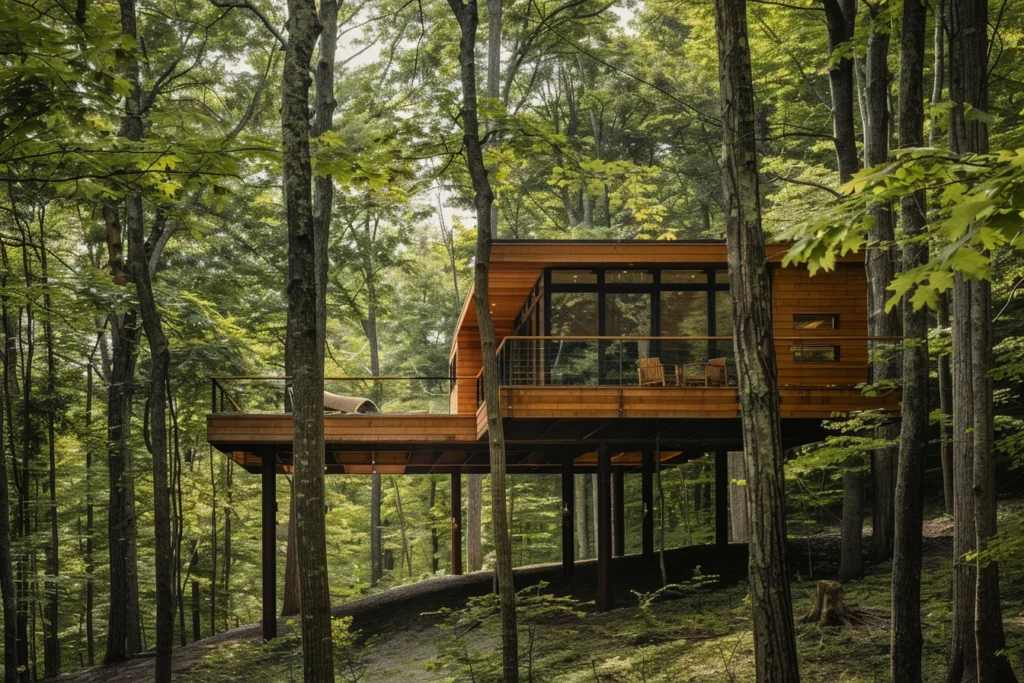
The Maintenance Reality
Elevated structures require ongoing intervention that rarely appears in project cost projections.
Tyler Robertson, building inspector with 28 years in residential and commercial construction, maintains a database of maintenance issues: “Elevated structures fail gradually. You don’t notice the deck fasteners corroding or the beam coatings failing until you have structural problems. By year 10-15, you’re looking at comprehensive refinishing, fastener replacement, and often structural reinforcement.”
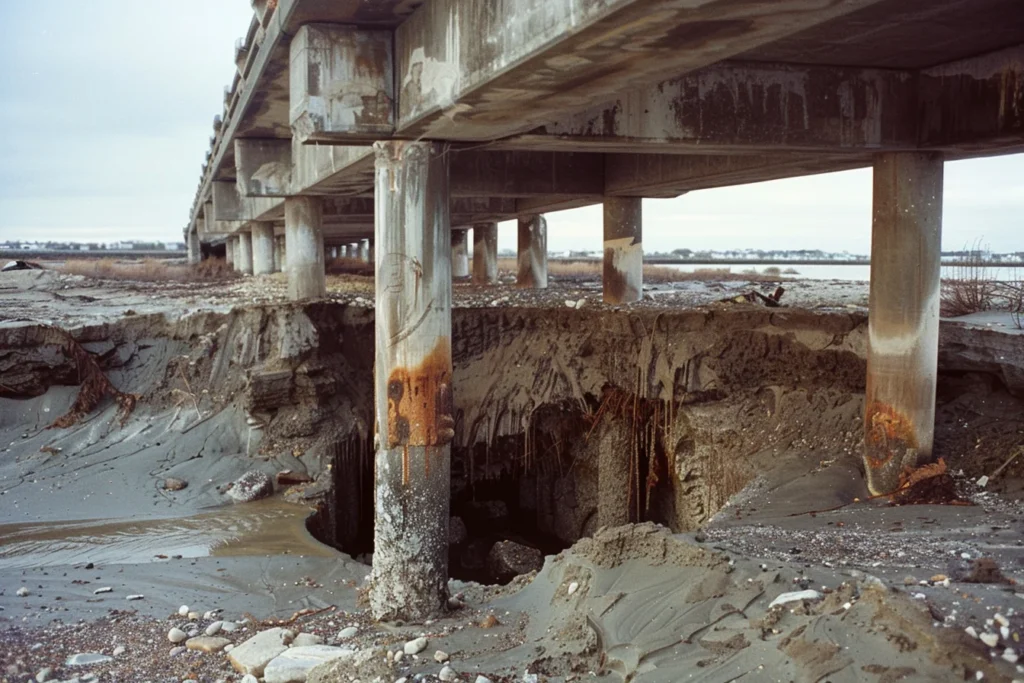
Typical 30-year maintenance schedule for elevated steel structures:
- Years 8-12: First comprehensive refinishing ($8,000-15,000)
- Years 15-18: Fastener/connection inspection and replacement ($5,000-12,000)
- Years 20-25: Decking replacement ($12,000-25,000)
- Years 25-30: Major structural assessment and potential pier reinforcement ($15,000-40,000)
Compare this to a well-executed slab-on-grade: minor crack repair and surface resealing, typically under $3,000 total over 30 years
- Pier plumbness and settlement
- Coating integrity on all steel members
- Fastener corrosion at beam-to-pier connections
- Decking moisture content and rot
- Joist deflection and bounce
- Drainage patterns and erosion
- Condensation on underside of floor assembly
- Bracing integrity
- Accessibility of utilities (plumbing, electrical under deck)
When Elevation Makes Sense
Despite the criticisms above, elevation remains the right choice in specific contexts.
Legitimate Use Cases
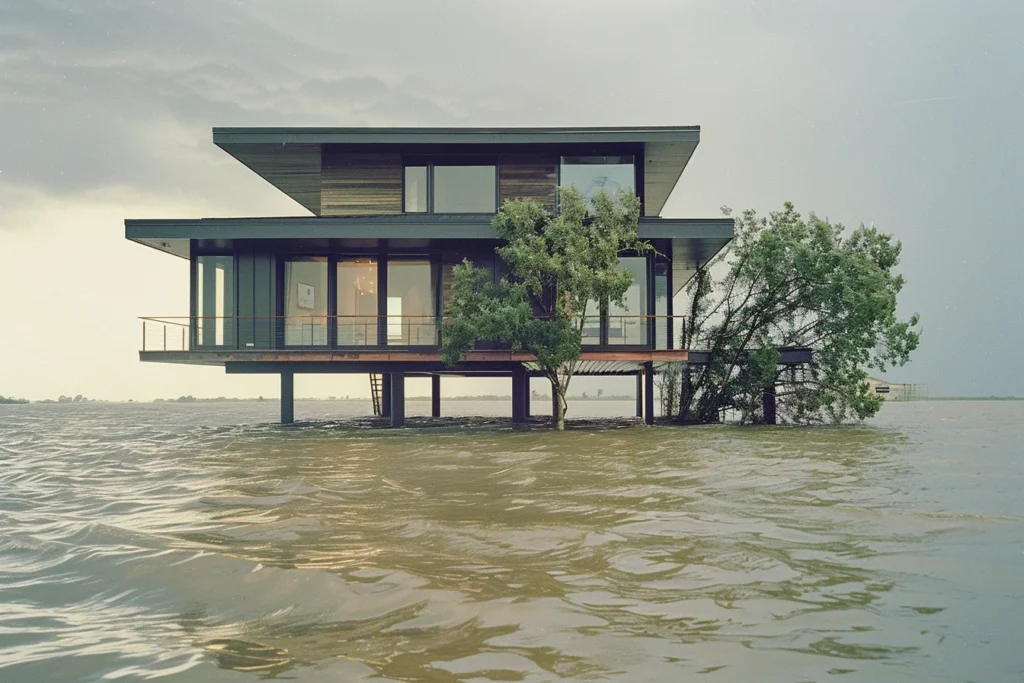
1. Flood Risk Mitigation
If your site lies in a FEMA-designated flood zone with base flood elevation requirements, elevation isn’t optional—it’s code. Moreover, it’s genuinely protective.
Threshold guideline: Flood recurrence interval of 1:50 years or greater → elevation justified
- Provides genuine resilience
- Reduces insurance costs
- Avoids repetitive loss from flood events
2. Steep or Highly Erosive Slopes
On slopes exceeding 15-20%, conventional foundation systems require extensive cut-and-fill. The earthwork often causes more ecological damage than an elevated pier system.
Dr. Elena Vasquez, landscape architect specializing in steep-site design: “The threshold is roughly 15 degrees of slope. Beyond that, the soil disturbance required for a conventional foundation—terracing, retaining walls, drainage systems—exceeds the impact of a pier system. Below that threshold, you’re usually better off working with selective grading.”
Calculation: If earthwork volume exceeds 50 cubic yards, evaluate pier system as alternative
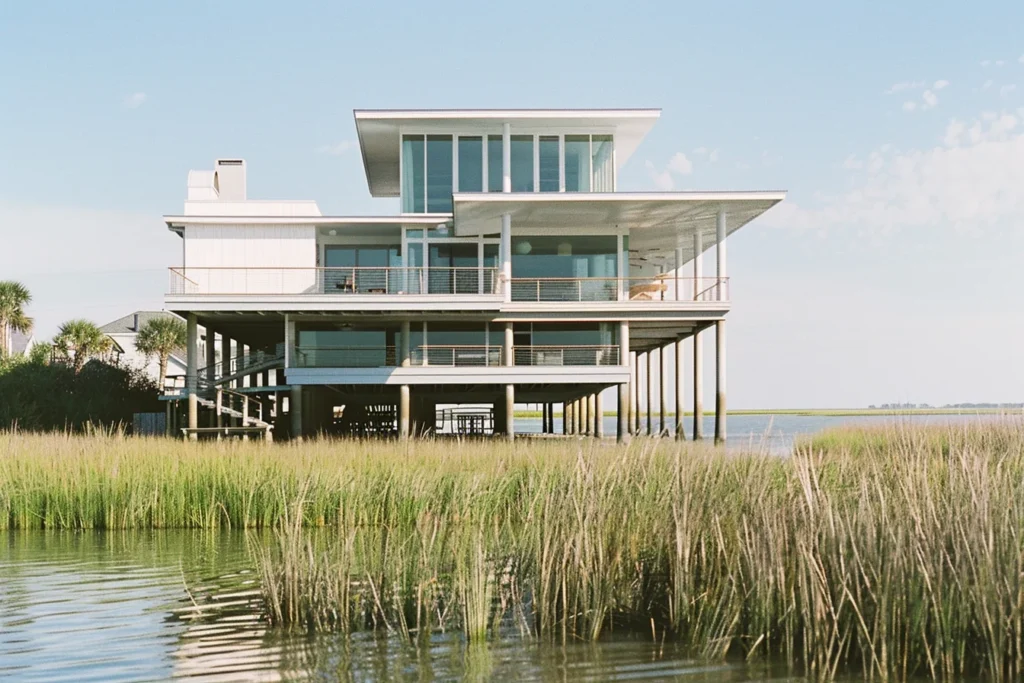
3. Archeological or Ecologically Sensitive Zones
Some sites contain features that absolutely cannot be disturbed:
- Archeological remains
- Critical habitat for endangered species
- Old-growth root systems
- Wetland buffers where fill is prohibited
In these cases, elevation is preservation by necessity, not choice.
4. Temporary or Relocatable Structures
If the building is designed for a limited lifespan or may need to be relocated, pier systems offer genuine advantages in reversibility.
The Key Principle
Quote from Dr. Margaret Soto, sustainable design consultant: “The key is not ‘never elevate,’ but ‘only elevate when you can’t design around it.’ If elevation is solving a genuine performance problem—flooding, slope, protection—do it well and accept the trade-offs. If elevation is solving an aesthetic problem or avoiding a difficult design conversation, reconsider.”
The Alternative: Selective Removal & Regenerative Planting
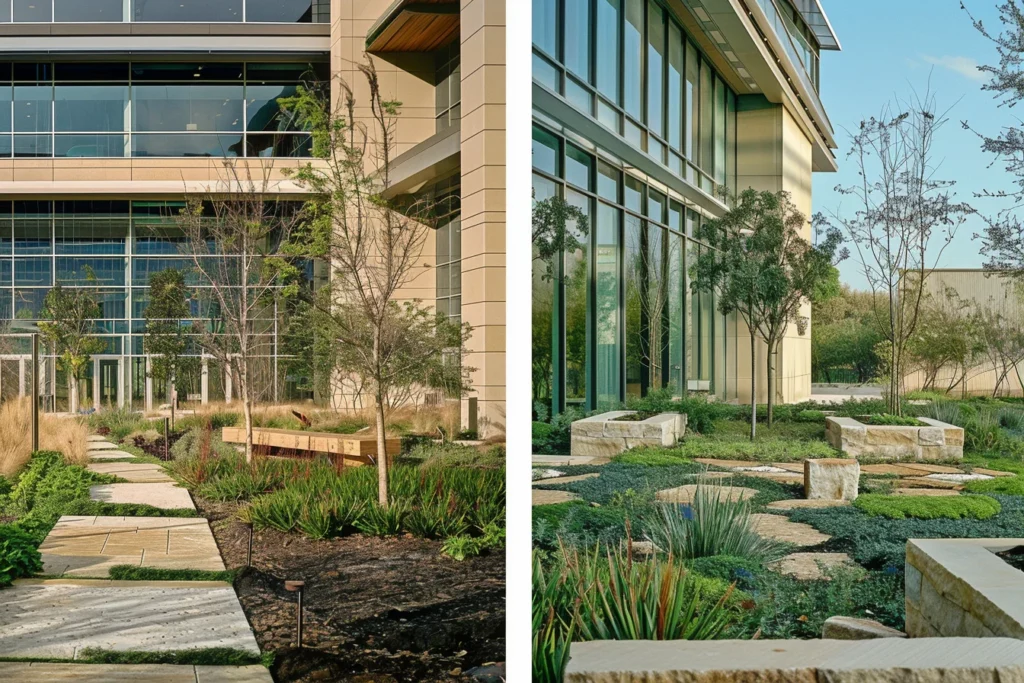
Sometimes the more sustainable path is counterintuitive: remove a small number of trees to avoid the elevated structure altogether.
Ecological ROI Over Decades
The standard environmental narrative treats every existing tree as sacred. But ecologists think in terms of system health over time, not static preservation.
Dr. James Whitmore, forest ecologist at University of Washington, challenged the preservation-at-all-costs mindset: “A site with three mature trees and nothing else isn’t ecologically rich—it’s ecologically stagnant. If removing one mature tree allows conventional construction and funding for planting thirty native saplings plus understory species, you’ve improved site biodiversity and long-term carbon sequestration.”
He explained the concept of ecological return on investment: “A healthy forest has multi-age canopy structure. Preserving only the oldest trees while preventing regeneration—which often happens when sites are disturbed but not fully cleared—can produce worse long-term outcomes than thoughtful selective removal followed by comprehensive native restoration.”
The 50-Year View
Consider two scenarios for the same site:
Scenario A: Maximum preservation via elevation
- Three mature oaks preserved (combined 140 lbs CO₂/year sequestration)
- Elevated structure adds 38,000 lbs embodied CO₂
- Limited budget remaining for additional plantings
- 50-year net carbon: +31,000 lbs CO₂ debt
Scenario B: Selective removal with regenerative planting
- One mature oak removed (loses 48 lbs CO₂/year sequestration)
- Conventional structure (38,000 lbs less embodied CO₂)
- Budget allows planting twenty native trees plus understory
- 50-year net carbon: -12,000 lbs CO₂ benefit
The math shifts when you account for the full system over time.
When to Choose Removal
Linda Hartwell, architect featured in our tree preservation case study, offered nuanced guidance: “My first instinct is always to preserve mature trees. But I’ve learned to ask: Is this tree healthy? Is it appropriately sited for the building program? Could we remove it, use that material value to fund comprehensive native planting, and create better overall site ecology?”
She described a project where removing two declining white pines allowed conventional construction and funded installation of forty native species: “Twenty years from now, that site will have richer biodiversity, better water infiltration, and higher total carbon sequestration than if we’d preserved two aging trees by elevating. It felt wrong in the moment. The data said it was right.”
Q: As an arborist who advocates for tree preservation, when do you recommend removal over building around a tree?
Maria Rodriguez, Certified Arborist: “If the tree is in structural decline—significant decay, root disease, storm damage—preservation may just be prolonging the inevitable. I’d rather see a diseased oak removed safely and replaced with two healthy saplings than see a structure designed around a tree that falls in five years.
Also, if preservation requires such extreme building gymnastics that you compromise building performance—creating unusable spaces, excessive HVAC loads, structural complexity—you’re not serving either the building or the environment well. Sometimes the best choice is removal with excellent replanting.”
Decision Matrix: The Nuanced Framework
The choice between elevated and conventional construction isn’t binary. Here’s a framework for evaluating trade-offs specific to your site and program.
Sustainability Trade-Off Comparison
| Factor | Pier & Beam Elevation | Slab-on-Grade | Hybrid Approach |
| Embodied Carbon | High (steel-intensive) | Moderate (concrete) | Moderate-High |
| Site Impact | Low (minimal excavation) | High (site disturbance) | Medium (selective) |
| Maintenance | High (refinishing, decay) | Low (minimal upkeep) | Medium (limited exposure) |
| Longevity | Variable (depends on materials) | High (50+ years) | Medium-High |
| Thermal Performance | Poor (bridging issues) | Excellent (insulated perimeter) | Good (reduced bridging) |
| Moisture Risk | Moderate-High (concentration) | Low (controlled drainage) | Low-Moderate |
| Accessibility | Poor (utilities, repairs) | Excellent (easy access) | Good |
| Cost Premium | +15-40% initial | Baseline | +10-20% initial |
| Flood Resilience | Excellent | Poor | Good (engineered) |
| Sloped Site Suitability | Excellent | Poor | Moderate |
The Interactive Tool
Just as we created a Tree Payback Calculator, we’ve developed an Elevation Trade-Off Tool that helps quantify these factors for your specific project.
Inputs:
- Site slope percentage
- Flood zone designation
- Number and health of existing trees
- Project budget range
- Climate zone
- Expected building lifespan
Outputs:
- Embodied carbon comparison (30-year lifecycle)
- Estimated maintenance costs over 30 years
- Site impact score (soil disturbance, tree loss)
- Recommended approach with sensitivity analysis
The tool doesn’t tell you what to do—it shows you what you’re trading.
Lessons from the Field
Theory matters. But what actually happens on the ground often tells a different story.
Project 1: The Pavilion That Wasn’t
Location: Asheville, North Carolina
Program: 1,200 sq ft educational pavilion in forest setting
Approach: Elevated steel structure to preserve understory
The Promise: Minimal site impact, preserve all existing vegetation, create floating experience in canopy
The Reality (Year 12):
- Pier coatings failed; active corrosion on 8 of 12 supports
- Deck boards showing significant rot despite pressure treatment
- Drainage concentration created 4-foot-deep erosion channel
- Repair estimate: $85,000 (original structure cost: $240,000)
Site manager Tom Brewster reflected: “We thought we were doing the right thing. But the steel wasn’t spec’d for the humidity levels we actually experience. Water management beneath the structure was an afterthought. Now we’re spending more to fix it than we saved by not clearing the site conventionally.”
Key Takeaway: If you elevate, spec for the actual long-term conditions, not the ideal ones. Budget for maintenance from day one.
Project 2: The Boardwalk That Rotted
Location: Seattle, Washington
Program: 400-foot elevated boardwalk through wetland buffer
Approach: Timber pier-and-beam with composite decking
The Promise: Provide wetland access without impact, educational amenity
The Reality (Year 8):
- Composite decking performed well
- Timber substructure showed extensive rot despite treatment
- Eight piers settling due to undermined footings from concentrated runoff
- Entire structure condemned as unsafe
Replacement approach: Engineered gravel path at grade with permeable surface and integrated bioswales—lower impact, lower maintenance, equal access.
Park director Rachel Kim: “We learned that ‘low impact’ elevation only works if the structure actually lasts. When it fails prematurely, you’ve impacted the site twice—once building it, again removing and replacing it.”
Key Takeaway: In high-moisture environments, timber elevated structures have shortened lifespans. Alternative access solutions may outperform despite higher initial site disturbance.
Project 3: The Floodplain Home That Got It Right
Location: Charleston, South Carolina
Program: 2,400 sq ft single-family home in FEMA Zone AE
Approach: Elevated concrete pier system with engineered breakaway walls
The Design Choices:
- Concrete piers rather than steel (longer lifespan in coastal environment)
- Properly engineered drainage system beneath structure
- Breakaway walls that collapse in flood events without damaging primary structure
- Utilities elevated and protected
- Comprehensive maintenance plan from day one
The Reality (Year 16):
- Structure survived two significant flood events (2015, 2018) with zero interior damage
- Neighbors on conventional foundations experienced $50,000-120,000 in flood repairs
- Annual maintenance costs averaging $800/year
- No structural issues; piers performing as designed
Homeowner James Chen (yes, same James from our tree preservation article—he gets around): “This wasn’t about aesthetics or environmental virtue signaling. We’re in a genuine flood zone. Elevation was engineering, not ideology. Because it solved a real problem, we invested in doing it right—proper materials, proper drainage, proper maintenance. It’s worked exactly as intended.”
Key Takeaway: When elevation solves a genuine performance requirement, invest in appropriate materials and maintenance. The economics work when the application is correct.
Conclusion: Sustainability Isn’t Elevation, It’s Judgmen
The elevated structure isn’t inherently good or bad. It’s a tool with specific appropriate applications.
The problem isn’t the tool—it’s the unexamined assumption that elevation equals environmental responsibility.
Good environmental design requires context-specific trade-offs, not aesthetic defaults. It demands that we measure what we’re actually achieving, not what we’re performing. It asks uncomfortable questions:
- Does preserving three trees justify 20 tons of additional embodied carbon?
- Would selective removal and comprehensive native replanting produce better ecological outcomes over 50 years?
- Are we elevating to solve a problem, or to signal virtue?
- Have we honestly assessed lifecycle maintenance, or are we externalizing that cost to the future?
The answers vary by site, climate, program, and context. There is no universal solution.
But there is a universal principle: Sustainable design isn’t about floating above nature—it’s about understanding when to step lightly, and when to step back.
Sometimes stepping back means acknowledging that conventional construction with thoughtful mitigation produces better total outcomes than elevated construction with problematic maintenance trajectories.
Sometimes stepping lightly means using piers appropriately—in flood zones, on steep slopes, in genuinely sensitive areas—and investing in the materials and maintenance to do it right.
The discipline is in doing the math, every time, for every site. Not assuming the answer before we’ve asked the question.
Additional Resources
- Lifecycle Assessment Database: Embodied carbon data for structural systems at EmbodiedCarbon.org
- FEMA Flood Maps: Determine if your site justifies flood-resistant elevation at MSC.FEMA.gov
- Maintenance Standards: Elevated structure inspection protocols at BuildingInspectors.org
- Native Planting Guides: Regional species selection at NativePlants.org