When shade becomes equity
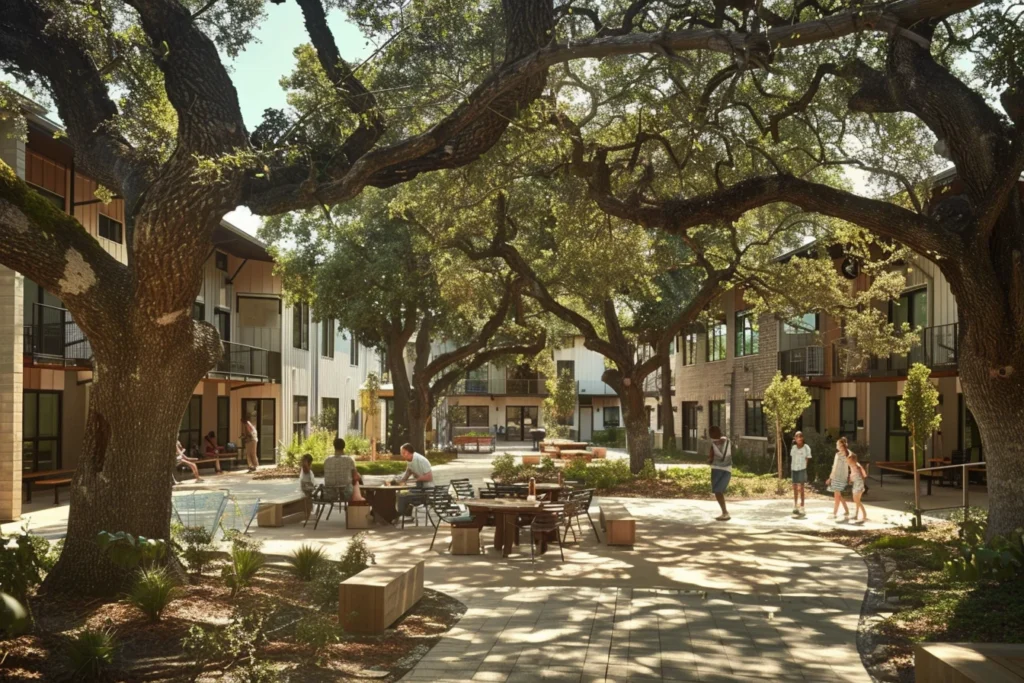
If we can design elevated villas to preserve trees for the wealthy, why not homes for everyone else?
The question sounds rhetorical. The answer is supposed to be “cost.” Affordable housing operates on razor-thin margins. Custom foundations, arborist consultations, site-sensitive design—these sound like luxuries reserved for $2 million hillside retreats.
But what if we’ve been thinking about this backwards?
What if tree preservation isn’t a premium feature to add—but a cost-saving strategy that’s been hiding in plain sight?
Why Trees Matter More in Affordable Housing
The communities that benefit most from mature tree canopy are the ones least likely to have it.
Dr. Sarah Chen, urban health researcher, has documented the disparity: “Low-income neighborhoods average 15-20% less tree cover than affluent areas in the same city. Yet these are precisely the communities experiencing greater heat vulnerability, higher energy burdens, and more limited access to cooling infrastructure.”
The data is stark:
- Mature tree shade reduces residential cooling costs by 20-30%
- Canopy coverage lowers ambient temperature by 5-10°F
- Tree-lined streets show 15% higher property values and faster appreciation
- Heat-related illness drops 40% in adequately shaded neighborhoods
A tree preserved is energy equity delivered.
When an affordable housing resident is spending 18% of income on utilities, that 20-30% cooling reduction isn’t aesthetic—it’s survival math.
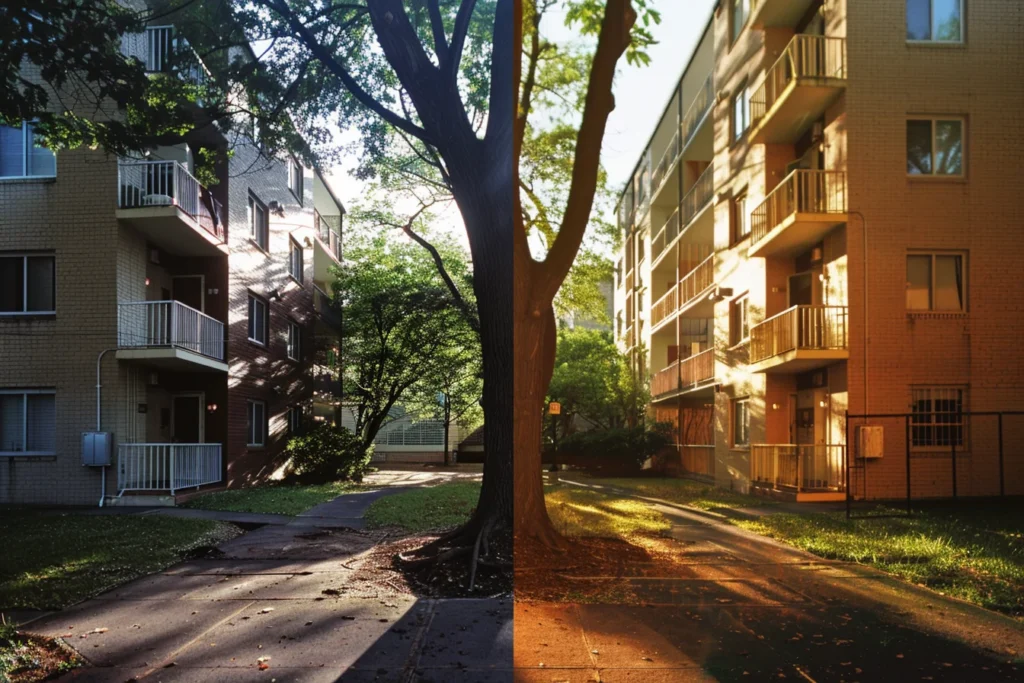
What It Actually Costs
Here’s the truth about tree-preservation design in affordable housing: the premium is smaller than assumed, and the payback is faster.
Austin Multiplex Case Study:
A fourplex development had four heritage live oaks positioned across 40% of the buildable area. Standard approach: clear and build. Alternative approach: design around them.
Cost delta:
- Pier-and-beam foundation modifications: +$18,000
- Arborist consultation and root mapping: +$2,400
- Modified grading plan: +$3,200
- Total premium: $23,600 (roughly 4% of total construction cost)
Payback:
- Annual HVAC savings (all units): $6,200
- Avoided landscaping/irrigation: $8,500 (one-time)
- Financial payback: 3.8 years
- Carbon payback: 2.1 years
But here’s what the numbers don’t show: resident feedback consistently mentioned the oaks as the primary reason they felt “lucky” to live there. The trees transformed the development from “affordable housing” to “a place people wanted to stay.”
[IMAGE 3: Before/after site plan showing building footprint designed around preserved trees]
The Design Toolkit (Abbreviated)
The gap between “we can’t afford to preserve trees” and “we can’t afford not to” is often just knowledge—knowing which tactics work at which price points.
Foundation Strategies:
- Helical piers: Minimal excavation, thread between root zones (~5-8% premium)
- Grade beams: Bridge over root areas without deep digging
- Pier-and-beam: Classic approach, higher maintenance but proven
Site Planning:
- Map root zones before schematic design (saves redesign costs)
- Orient buildings to maximize existing shade on west/south walls
- Use permeable pavers under canopy (reduces stormwater infrastructure)
The Decision Framework:
Not every tree is worth preserving at any cost. We use a three-tier triage:
- Preserve: Healthy mature canopy species, reasonable cost (<10% premium)
- Consider: Medium value, higher cost (10-15% premium)—run the payback math
- Replace: Diseased, invasive, or preservation cost >15%
The framework includes carbon calculations, energy modeling, and lifecycle cost analysis—but we’ve found the tipping points are surprisingly consistent across climates and typologies.
What Changes at Scale
Individual projects prove the concept. But systems change happens through policy.
Portland’s approach: Affordable housing developers who preserve mature trees receive:
- Expedited permitting (saving 45-60 days)
- Reduced impact fees (averaging $8,000 per unit)
- Additional height/density allowances in exchange for canopy retention
Result: Tree preservation rates in affordable housing increased from 12% to 47% of eligible projects in three years.
Brooklyn’s innovation: The city created a “Green Canopy Fund” that directly subsidizes the foundation cost premium for affordable housing projects preserving mature trees. Funded through a surcharge on luxury developments that clear sites.
These aren’t charity programs—they’re recognizing that urban tree canopy is public health infrastructure.
The Missing Conversation
Here’s what we’re not discussing enough in affordable housing design:
Thermal equity. We obsess over square footage and unit count, but rarely over how hot those units get in July. A 600 sq ft apartment under a mature oak is more livable than an 800 sq ft unit in full sun.
Longevity. Trees preserved today will still be providing shade, cooling, and value in 50 years. The HVAC unit we’re speccing? Replaced three times in that span.
Dignity. Yes, the carbon math works. Yes, the energy savings are real. But there’s something else: residents in tree-preserved affordable housing report feeling more “at home” and express greater pride in their neighborhood. That’s not quantifiable, but it matters.
Designing Shade as a Social Good
The future of sustainability isn’t about luxury eco-villas that few can afford. It’s about democratizing access to the environmental amenities that should be basic: shade, thermal comfort, connection to living systems.
Preserving trees in affordable housing isn’t charity. It’s not even just good design.
It’s recognizing that the people who can least afford high energy bills deserve the cooling infrastructure that reduces them.
The tools exist. The economics work. The policy mechanisms are emerging. What’s needed now is a shift in how we frame the question.
Not: “Can we afford to preserve these trees?”
But: “Can we afford to cut them down?”
What We’re Working On
We’re developing a comprehensive Affordable Tree-Preservation Toolkit that includes:
- Cost estimation models for different foundation strategies
- Energy payback calculators specific to affordable housing metrics
- Root zone mapping protocols that don’t require expensive arborist surveys
- Policy templates cities can adapt for preservation incentives
- Case study library with complete financial breakdowns
The challenge: Every climate zone, soil type, and tree species combination creates different variables. Cookie-cutter solutions don’t work.
What we need: More projects. More data. More developers willing to try the approach and share results.
If you’re working on affordable housing and want to explore tree-preservation design for your project, we’d love to talk. We’re especially interested in:
- Projects in climate zones we haven’t documented yet
- Novel foundation approaches that reduce the cost premium
- Policy innovations your city is considering
- Failed attempts (we learn as much from what didn’t work)
Get in Touch
Considering tree preservation for your affordable housing project?
Contact us to discuss:
- Site-specific feasibility assessment
- Cost-benefit analysis for your context
- Foundation strategy recommendations
- Policy navigation and incentive applications
Researching this topic for policy or academic work?
We’re building a collaborative database of tree-preservation outcomes in affordable housing. Data sharing partnerships welcome.
“Preserving trees shouldn’t be a luxury. It should be code.”